Tuesday, 19 December 2017

What is important, cost or reliability of supply?

From World Economic Forum
Like the island of Mauritius, UK has an electricity supply system with reliability of well over 99.9%. This is unheard of in most of the less developed world.
Despite our lax and irresponsible use of electricity, we continue to throw money at the problem of peak demand.
In countries where this is not an option, the lights go out on a regular basis, and people suffer. Vaccines and other medicines are damaged through lack of refrigeration, children can't study, vital communication systems are disrupted.
Will we wait until we are in the same boat before we do enough  in UK to flatten our demand?
Its up to all of us to raise awareness.

Friday, 1 December 2017

Firm Frequency Response - what is it and why do we need it?


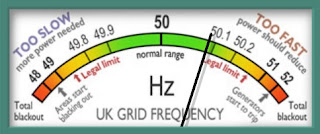
Our electricity system operates at a frequency of 50Hz, within limits as above.
Currently (no pun intended!) the National Grid is calling for suppliers to quote for fast response generation and/or storage to keep the frequency within its narrow boundaries.

There are two ways of looking at this: either

  •  it is a commendable and efficient way to address peak capacity issues, only paying for generation that is actually needed
or
  • it is an admission of failure to communicate to the consuming public the value of relatively modest changes in behaviour that would substantially reduce peak demand and render such projects unnecessary
Which view you take will depend on your faith in humanity's ability to respond effectively to calls for responsible action, or your belief in a centralised top-down system that makes no serious effort to raise public awareness of the value of behaviour change.

We are in danger of being reduced to cargo-cult status, where collectively we receive benefits from above that we can neither influence nor understand.


Friday, 29 September 2017

Share of Renewables in Total Generation Looking Good - How can it be Increased Further?

We reached 30% of electricity from renewables in quarter 2 of 2017 - thank you Regen SW for your Graphic of the Month. But this is only for one quarter - the average for 2016 was 24%.

Will we get to 30% for a whole year by 2020, which is the national target?

The seasonal variations in wind and solar PV suggest that what is most needed is more wind power to boost Q4 and Q1 generation, when solar is at its lowest, and wind is statistically higher.Reading from the graph, this would require wind going from around 12% to 18% of generation in those quarters, a 50% increase in wind generation.

You can forget storage as a means of ironing out seasonal variation - a battery large enough to store electricity in sufficient quantity to shift supply for several months would be very big, even more expensive than more nuclear power.

Any ideas on how to shift consumption from winter to summer? More energy efficient homes would help!

Monday, 4 September 2017

Falling Carbon Intensity - Can we Keep it Falling?


As this excellent graphic from Regen SW shows, we have successfully halved the carbon intensity of our electricity supply over the last 25 years.
Much of this was due to the substitution of gas for coal in the 1990's. A further, but lesser drop is due to the more recent substitution of renewables for coal, over the last five years.
But how do we keep this  rate of progress up?
It's not good enough just to say with more renewables - they are intermittent and do not occur in reliable quantity when we most need them, on cold dark winter evenings.
The answer is to shift when we use electricity, away from peak times and into times of low demand and when the sun is shining or the wind is blowing.
As a first step, you innovators and early adopters already know what to do... and to tell your friends!

Thursday, 10 August 2017

How Fast are our Consumption and Generation Patterns Changing?


Oh dear, another set of graphs!

The good news is I only want to look at the right hand side one - you can see how since 2013, coal has plummeted, and gas has more modestly increased. Nuclear has stayed more or less constant, solar and wind have increased but are still a very small part of the total.
Here's another perspective - the modest decline in overall demand is accentuated in total fossil consumption - i.e. coal and gas together have declined faster than consumption, because renewables, nuclear and interconnectors have all increased.

For the green renewable line to go up further and faster we will need much more demand side response - so get time-shifting and tell your friends!

Monday, 7 August 2017

Solar Share of Generation in Europe is Plateauing


The share of electricity generation in countries known for their keen pursuit of it in the past, notably Germany, has plateaued.

In Germany's case, at 6% of generation. Sunny Greece and Italy are marginally better at around 8%.
Germany has a moratorium on nuclear power, but this has not caused an increase in solar electricity generation.

There are technical as well as political reasons for this.

It gets progressively harder to increase solar's share of generation, particularly in countries where the supply and demand are substantially out of sync with each other, as is the case in Northern Europe.

The answer? More time-shifting of domestic demand of course!


Thursday, 3 August 2017

Hi , I'm Tom Langdon-Davies from a farm near Exeter in sunny Devon, South West England. I have worked all over the world for energy companies, renewable and conventional. Now it's time for me to see what I can do to raise awareness of the easy things we can do to make our energy more sustainable. Thanks for reading. Please help me by commenting!


After a brief spell seismic surveying around Europe and Africa, I ran the Natural Energy Centre in London - that was back in 1977, and we did it all. Wind, solar, heat pumps, biomass. After that I did a stint at the Electricity Council in Millbank , encouraging night-time battery charging, back when the UK electricity supply industry was still nationalised.
We moved to Devon in 1984, installed solar PV, wood-burning stoves, and I got a grant to put in a biomass supply system at Occombe Farm in Torbay.
Devon and Cornwall are now blessed with more wind and solar electricity than they can use - unless we start to seriously shift when we use it, from times of peak demand to times of trough demand, and also into times when the sun is shining and the wind is blowing.
Please take a look at the blogs I have written over the last two years - and comment on them or publicise them. Let me know if I can do the same for you!
Thanks